GUIDE
What a birth chart is and how to read it, step by step
A birth chart is a map of the sky at the exact moment you were born, seen from the place where you were born. It looks like a circle full of symbols, but it is read in layers, and each one tells something different about you. This guide explains what each part is and in what order to look at them.
What a birth chart is
It is a map of the sky at the exact moment you were born, seen from the place where you were born. It shows where the Sun, the Moon and the planets were, in which signs and in which parts of the sky. Birth chart, natal chart and astrological chart are three names for the same thing.
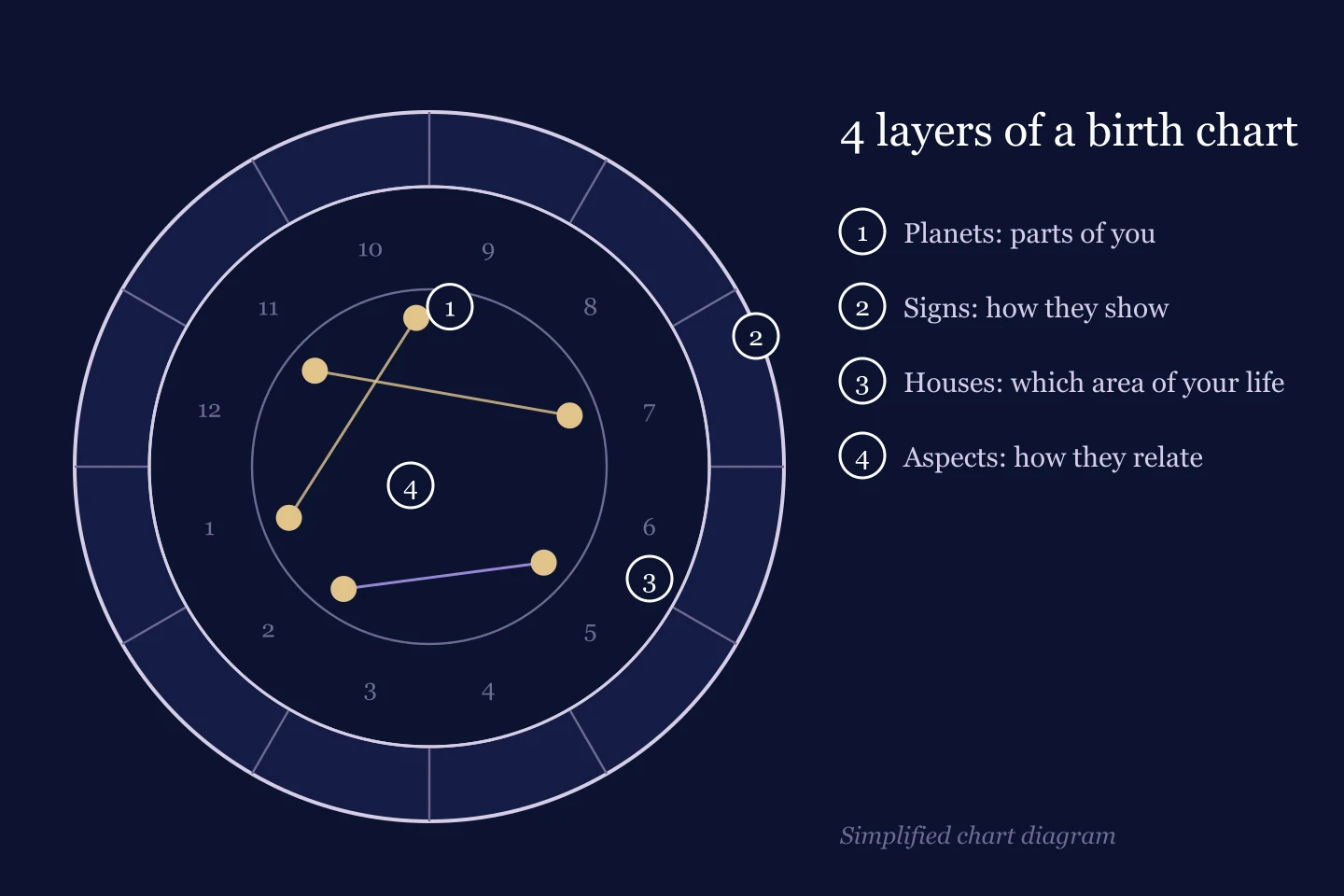
It is drawn as a wheel. It looks complicated, but it is read in layers, and each layer tells something different about you.
What details you need
Your date of birth, your time of birth as exact as possible and the city. With the date alone you can see the Sun and almost always the Moon; with the time and place, the rising sign and the houses are worked out too, and they are the most personal part of the chart.
The time is usually on your birth certificate or in hospital papers. If it is approximate, say so: that way it is taken into account in the reading.
Layer 1: the planets
Each planet stands for a part of you. The Sun, your essence and what drives you; the Moon, your emotions and what you need to feel at home; Mercury, how you think and speak; Venus, how you love and what attracts you; Mars, how you act, how you desire and how you defend yourself.
Jupiter speaks of where you grow and find luck; Saturn, of your limits and what demands effort from you; Uranus, Neptune and Pluto, which move very slowly, of the big themes you share with your generation.
Layer 2: the signs
The sign each planet is in tells how that part of you expresses itself. A Venus in Aries, direct and impulsive in love, is not the same as a Venus in Taurus, which looks for calm, steadiness and simple pleasures; nor is a Mercury in Gemini, quick and curious, the same as one in Capricorn, practical and orderly.
The twelve signs are grouped by element, fire, earth, air and water, and seeing which element is plentiful or missing in your chart already says a lot about your temperament.
Layer 3: the twelve houses
The houses divide the chart into twelve areas of life: 1, your personality and how you come across; 2, money and what you value; 3, communication and your close surroundings; 4, home and family; 5, love, play and creativity; 6, daily life and habits; 7, partnership; 8, crises, deep change and what is shared; 9, travel, study and beliefs; 10, vocation and public image; 11, friendships and projects; 12, your inner world.
The house a planet falls in tells where that energy shows most. A Venus in the 10th house, for example, is read in relation to work and image; in the 4th, to home.
Layer 4: the aspects
Aspects are the angles the planets form with each other: how they get along. Some are read as harmony and ease, like the trine and the sextile; others as tension that pushes you to grow, like the square and the opposition. The conjunction, when two planets are together, merges their energies into one.
Aspects are what make your chart unique: two people with the Sun in the same sign can live it in very different ways depending on the aspects it receives.
How to read your chart, step by step
Start with your Sun, your Moon and your rising sign: they are the base. Then look at where Venus and Mars are, which speak of love and desire. Then notice which houses your planets fall in, especially if several gather in the same house or sign. Leave the aspects for last, because they add nuance to everything else.
Take your time: it is better to understand three pieces well than to skim all thirty.
An example: reading a single piece
Picture a Moon in Cancer in the 4th house. The Moon speaks of your emotions; Cancer, of caring and feeling safe; the 4th house, of home and family. Together they read as someone who needs a warm home to be at peace, who looks after their people and keeps much of what they feel for those closest to them.
That is how each piece is read: planet, sign and house, and then the aspects it receives. With three or four pieces read this way you already have a fairly faithful portrait.
And if you want to look at a relationship
To see how two people fit, comparing Sun signs is not enough: the two charts are crossed, looking at how your planets touch the other person’s. This is called synastry or a compatibility chart, and it always starts from both birth charts.
Birth chart, transits and solar return
The birth chart does not change: it is the one from your birth. What changes is the sky at each moment. Transits look at how today’s planets touch the ones in your chart, and the solar return, the chart of your birthday each year, shows the themes of that year, from birthday to birthday.
Elements and modalities
A quick way to get a feel for your chart is to count which elements your planets are in. Lots of fire is linked to enthusiasm and drive; lots of earth, to practical sense; lots of air, to ideas and relationships; lots of water, to sensitivity and intuition. What is missing is read too: an empty element is often something you find hard or look for in others.
The signs are also divided into cardinal, which start things; fixed, which sustain them; and mutable, which adapt. Seeing which one dominates tells you whether you are more of a starter, a keeper or a changer.
What you can read yourself, and what needs a reading
With this guide you can recognise the pieces of your chart and start with the base: Sun, Moon and rising sign. What is harder to do on your own is putting it all together: how the planets, signs, houses and aspects combine into one story. That synthesis is exactly what a birth chart reading does.
Common mistakes
Sticking to the Sun sign alone. Reading the houses without a reliable birth time. Taking a tense aspect as something bad, when it is often what makes you grow most. And reading the chart as a fixed destiny: it describes tendencies and talents, not what will happen to you no matter what.
Where a ritual fits
If you want your whole chart read, Celeste Nova’s full birth chart explains your planets, houses and aspects in a clear PDF, within 3–5 days.
Questions
Is a birth chart the same as a natal chart?
Yes: they are two names for the same thing, the map of the sky when you were born.
Can I get my birth chart without my birth time?
Yes, but without the rising sign or the houses. The planets in the signs and their aspects can still be read.
Does the birth chart change?
No, it is the one from your birth. What changes is the sky at each moment, which is read through transits or the solar return.
What is the midheaven?
It is the highest point of the chart, where the 10th house begins. Astrology links it to vocation and to how the world sees you.
How long does a full birth chart take?
Ours reaches you as a PDF within 3–5 days, in your private space.
More guides
Content for spiritual and entertainment purposes. It does not replace medical, psychological, legal or financial advice.